

Root Canals
Why Do I Need a Root Canal?
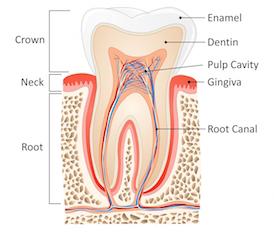 There are many reasons that root canal therapy (also known as endodontic therapy) may be recommended for your tooth. The most common reason for requiring a root canal is a large cavity that has progressed deep into your tooth. Sensitive nerve tissues lie at the very center of teeth and travel in canals in the centers of the roots of teeth. Once bacteria from the cavity reach this nerve tissue, the tooth often becomes sensitive or painful. A root canal is the only successful method of treating this toothache other than extracting (removing) the tooth.
Other situations that may require a root canal are deep cracks or chips in a tooth. Sometimes a tooth may become infected without any pain or discomfort, but even in the absence of pain, a root canal may be needed to restore the tooth to health. Less frequently, a root canal may be recommended as a preventive measure so that planned dental work such as a crown or bridge will not result in future discomfort.
Persistent pain is often the first indication that something is wrong and that a root canal may be needed. However in some cases, we can spot an infection developing before it ever causes pain. It can come as a surprise to patients who are not yet in any discomfort that they have a deep cavity or mild infection that may require a root canal. If we spot a problem like this on an x-ray, we will show you so that you can see why we are recommending a particular treatment.
Root canal therapy allows us to treat the infection, relieve your discomfort, and save a tooth that might otherwise be lost.
How Is a Root Canal Done?
 With all dental treatment, including root canal treatment, your comfort is our highest priority. The root canal will not be performed until we are sure that you are totally numb. In almost all cases, there is no pain during the procedure at all since you will be totally numb just as you would be for any other dental procedure.
Once you are numb and comfortable, Dr. Wahlers will remove any infected or inflamed nerve tissue and then sterilize the inside of the tooth and roots. At the end of the procedure, the empty canals in the roots of the tooth are sealed with a sealing material called gutta percha and then a filling is placed. During the procedure, two or three x-rays are typically taken for measurement purposes.
We often recommend a crown on a tooth that has had root canal therapy because removing the root can cause the tooth to become brittle. A crown protects the tooth and restores it to full function.
You may experience some discomfort or sensitivity for a day or so after the numbness goes away. Dr Wahlers can discuss with you whether or not any pain medication such as ibuprofen or Tylenol would be recommended.
Are You in Pain?
Are you experiencing pain? Pain is a sign that something is wrong. We can help. Call our East Norristown dental office today. We’ll perform a thorough examination and determine the cause of the pain and the appropriate treatment.
